While on a trip to Cabo San Lucas in 2005, I saw a tree that I really liked. The tree was quite large, with an overhead canopy some thirty feet high.

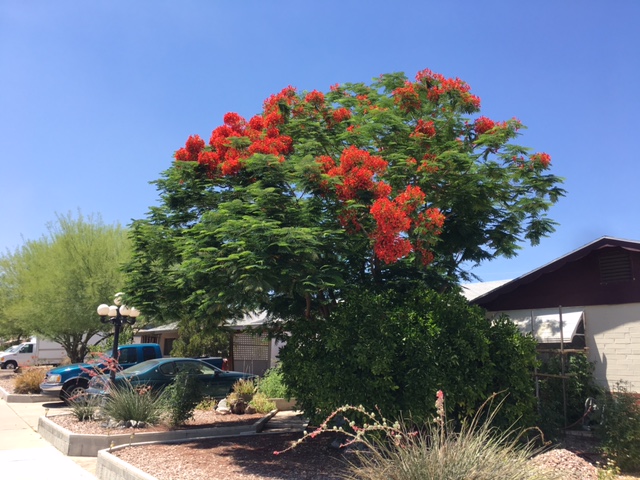
The lowest limbs were four, five, even six feet off the ground. The leaves are small, oval in shape and arranged in a feathery fern type pattern on stems that are about a foot long. At certain times of the year, there are red or orange flowers growing at the tops of the branches, almost displacing the green leaves.
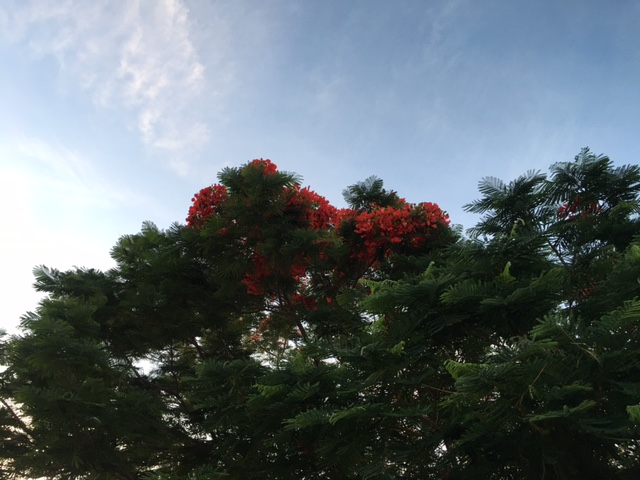
Some of the trees I saw had so much flower that it was almost totally red. Hanging from the branches were brown beans that were 12 to 16 inches in length, 1/2 inch thick and about 3 inches wide. Inside these beans, there are individual seeds.
Then when I went to Australia a few years later, I saw the same type of tree.
Then I saw this tree in the Bahamas.
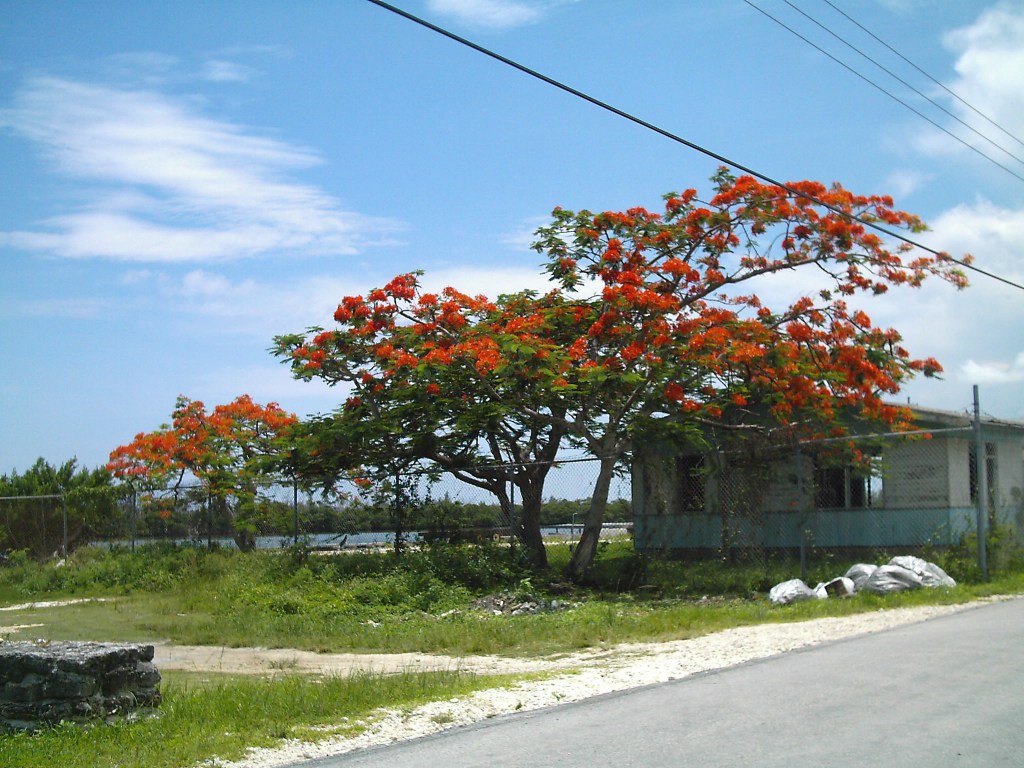
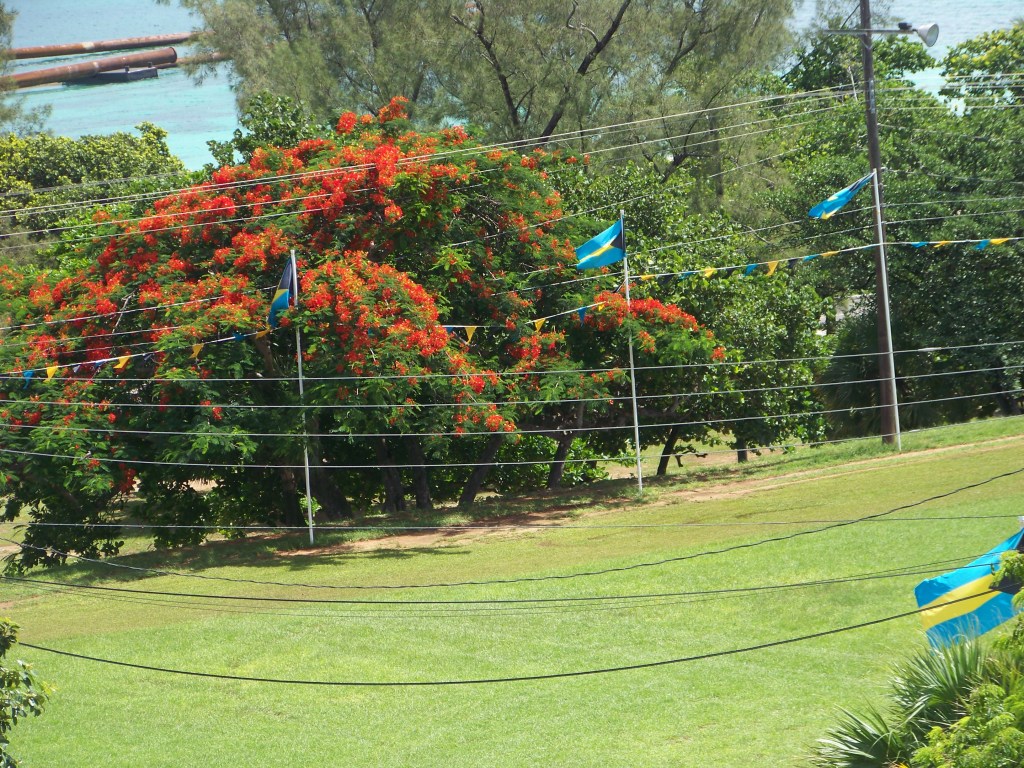
On a subsequent trip to Cabo, I even saw a few that had yellow or orange flowers.
I have seen them quite often in Hawaii.
I’ve collected seeds from Australia, Fiji, Florida, California, the Bahamas and Hawaii.
I learned that this is called a Royal Ponciana Tree. . . sometimes called a flame tree. It grows in tropical locations with lots of sunshine and rain.
I liked the tree so much that I gathered some of the brown beans and brought them home (smuggled them in). I broke the beans open and took out the seeds. There are around a dozen seeds in each bean or pod, depending on the size (length) of the pod.
Then I planted half a dozen of these seeds in to a pot. I kept them wet and warm and in the sun. It took over a month before they germinated and started to come up. I ended up with four fern like plants. When they got to be about a foot and a half tall, I transplanted them to bigger individual, pots. Three of them died immediately. Probably more as a result of my transplanting skills than anything else, but one survived.
At the time, we were redoing the front yard landscasping. – getting rid of the grass –

and I created a small planter – just an indented area about 2 foot by three foot surrounded by a concrete curb totally under the ground surface – and planted the one remaining tree there. It struggled and I babied it. During the winter, around the end of November, all the leaves fell off. It liked like a couple of sticks. I built a frame over it and covered it with a light sheet and put in a night light for heat.
Come March, I was ready to give up on it as being a lost cause and removed the sheet, framework, and the night light . I did some research and found that the Royal Ponciana survives in USDA Hardiness Zones 10 thru 12. Hawaii is Zone 11 and 12, Puerto Rico is totally Zone 12, the bottom 1/4 of Florida is zone 10, as is the very southern tip of Texas, Southwestern Arizona around Yuma, and Southern California from Los Angeles to San Diego. The Phoenix Area is more like zone 8 or 9.
Just as I was ready to cut out the two little sticks remaining, I saw some green on one of the sticks. A few weeks later, there was a few small green buds on one of the sticks. I started another dozen seeds in a pot inside the house. Slowly, the one planted outside grew leaves and branches. By the end of May, it was fully covered in leafy fern like fronds.

It grew taller and bushier. In August, three little plants came up in my pot. By October, the one outside was almost three feet tall. I rebuilt the frame work around and over the small bush. In November, I began covering it at night. In December, I started with the night light – basically just a single bare 40 watt incandescent light bulb. All the leaves fell off and it was just sticks.
In March, I removed the framework. The ponciana was just sticks. It wasn’t until late April until the buds started to come out. and I had three plants growing in the pot inside the house.
This third winter, it was over four feet tall and it took three sheets to cover it. Come springtime, I transplanted two of the plants from the pot into the small planter.

The fourth winter, I began covering the main trunk and branches with newspaper. I would wrap two or three layers of newspaper aroung the branches and tied them in place with string. The framework with old sheets was over six feet tall, and I had added a second light bulb.
The fifth winter, I did not include the night lights, but insulated the trunks and branches with newspapers as before.

The sixth winter, I only insulated the branches.
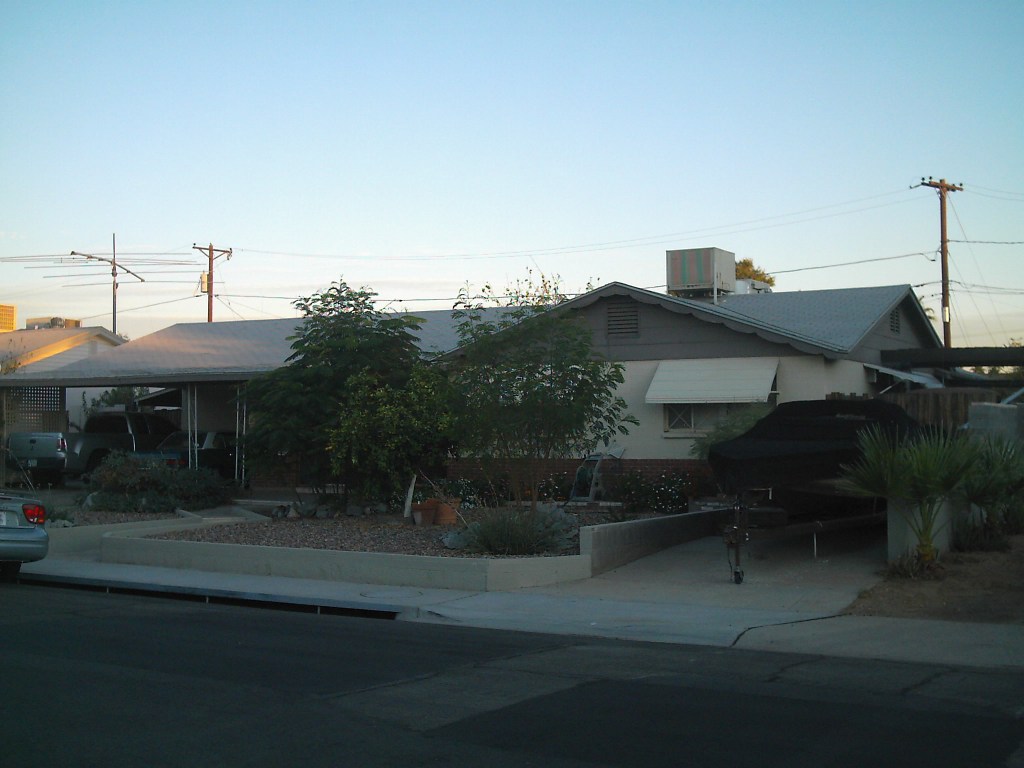
This is what happens to it in December and January each year.
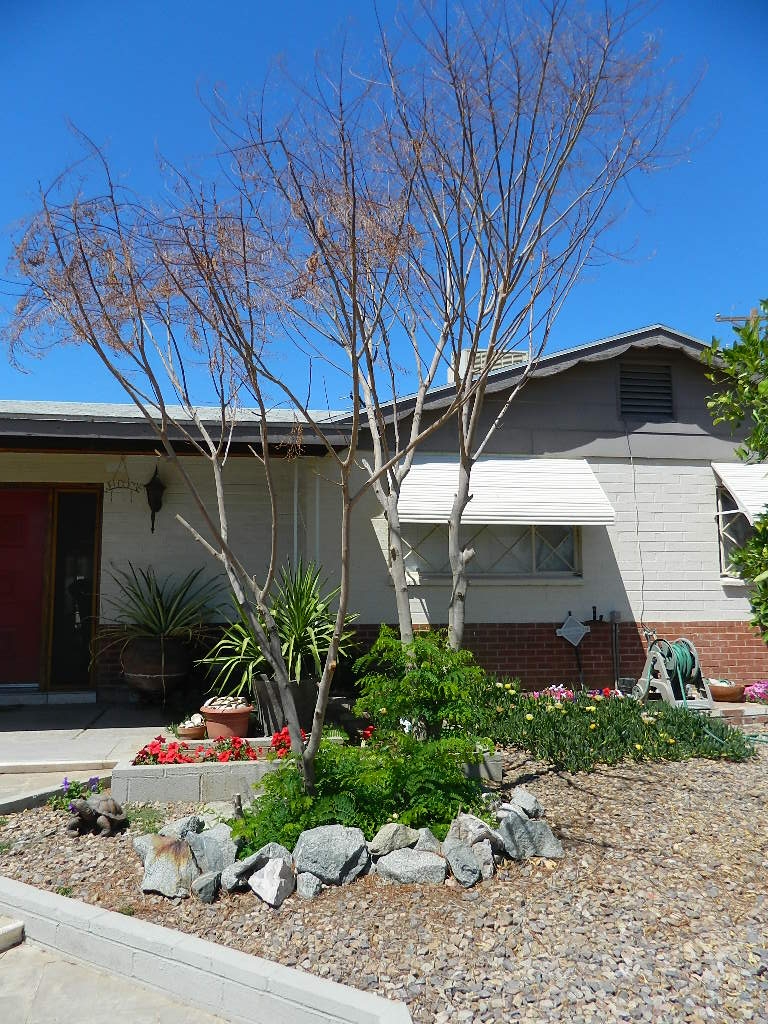
The 9th year we got a few red flowers, and the tenth year, we even got a small single bean – with no seed inside.
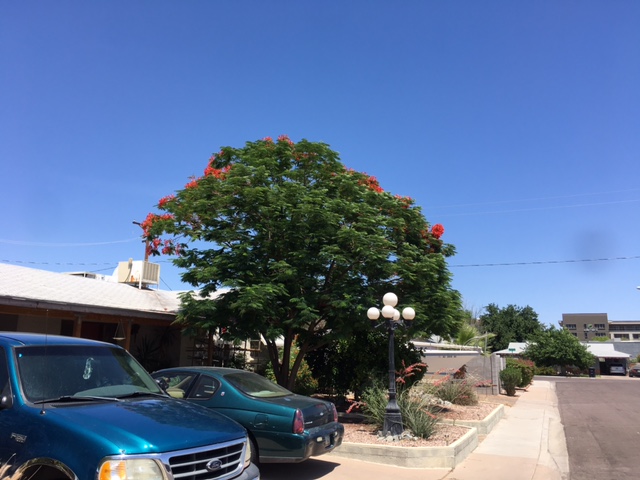
It has been 12 years. The canopy is over 25 feet tall, covers much of the front yard and now, in May, almost a fourth of the trees top is covered in red flowers.
I plan on planting some of these seeds in Hawaii. I just haven’t decided on where.
TTFN
 TropicalCastaway