While coronavirus vaccines are distributed around the world, a Geneva-based nonprofit is teaming up with airlines and The World Economic Forum to create a “vaccine passport” app to ease air travel during the pandemic. They say the digital credentials can also be used at stadiums, movie theaters and offices. According to developers, users will receive a private QR code once test results or proof of vaccination are uploaded. IBM has developed a similar app, Digital Health Pass, that lets companies and venues customize what they require for entry to a physical location.
The holidays have seen a sharp increase in air travel: The Transportation Security Administration reports it screened a pandemic record of 1.28 million people on Sunday.
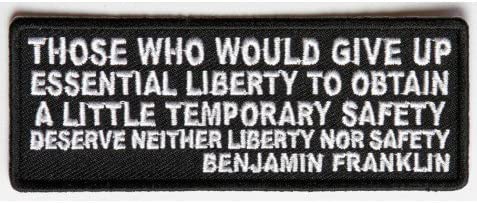
I anticipate that soon we will need to have this to go to the grocery store, to church, to school, to restaurants, movie theatres, the post office – basically every time you go out your front door. The modern day “Show me your papers”
Currently, we see people standing on the street corners with all kinds of signs asking for help. The new sign will read something like this: “NO CELL PHONE. NO COVID APP. NEED HELP!”
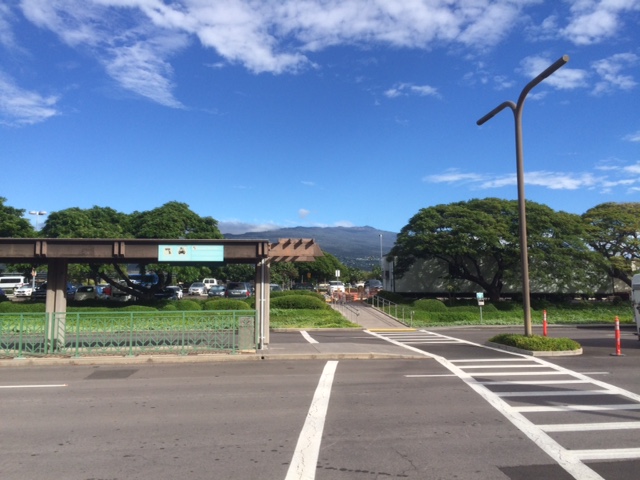
After spending a week in Hawai’i in September of 2018, we were scheduled to return on a flight out of Kona at 10 PM on United Airlines. We arrived at the airport around 7:30 PM and returned the rental car. The shuttle dropped us off at the terminal and we proceeded through the TSA gauntlet and out towards the gates. As we passed from the central patio area in the terminal where the shops and the restaurant are located into the section for gates 1 – 4, we passed through an agriculture checkpoint.
When you arrive in Hawaii, you are given a form (one per family) that you must fill out while still on the airplane. The flight attendants pass them out (but they do not provide pens or pencils) and you indicate if you are bringing any agriculture products into the state. . . anything such as fruits, vegetables, seeds, plants, soil, – the form even asks if you might possibly have soil on your shoes from a farm or agriculture location – need to be declared. Theoretically, once you have declared these items, someone from the State Agriculture Department will inspect them and if they are safe for the ariculture of Hawaii, you may bring them in. If not, they will confiscate them. ( just a word to the wise – they confisgate everything) If you do not declare them, then it is a major violation and you get fifty lashes with a wet noodle, or a ten thousand dollar fine, or six months in jail, or any combination of the three. I have yet to see any Agriculture inspector at Kona when we arrive, but I have seen them in Honolulu.
I tell you this, because I am aware that Hawaii stresses the need to protect their fragile environment. What I was not aware of, was the need to protect the environment of everywhere else. But apparently there is. As I said, when we went into the gate area, there was an agriculture inspector there and we were told to put all our bags through their conveyor/scanner. Apparently, you cannot take any fruits of vegetables with you from Hawaii. Anything that you had purchased at the duty free shops in the airport did not need to be checked, because when you purchased it, part of the purchase price was funneled to the state as payola. . . no, wait, I didn’t say that out load did I? It has been disinfected – yeah, . . . that’s it.
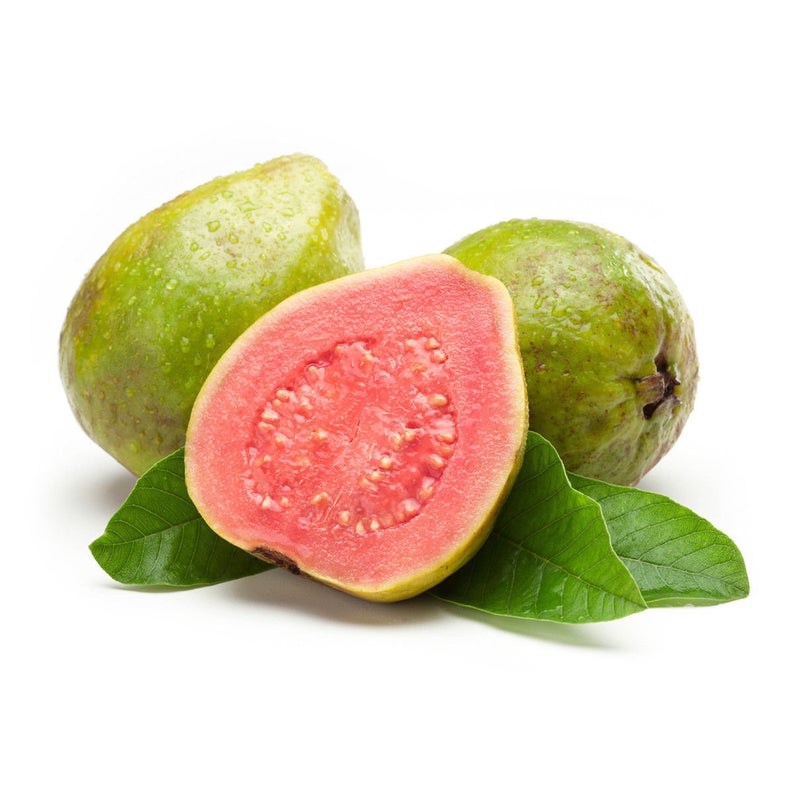
A guava as found on Hawai’i
Anyway, as we passed through this checkpoint, we had two apples that we intended to eat on the trip back home along with four guavas. Major violation! They took these away from us and gave us a lecture about the dangers of infecting agriculture. OK, Alright, already! Take the damned fruit. Add it to your stash that you have taken from other passengers. Spare me the lecture! My wife was not so forgiving. She wanted to argue the point.
As we sit at the gate, I notice that there is a line of people standing at a little building next to the gate openings. My wife is giving the agriculture guys the evil eye! The announcer says over the loudspeaker that our flight has been delayed for an hour due to mechanical difficulties. Now I want one of my apples back for something to eat during the next hour’s wait. No such luck! So we sit and we wait. The line at the little building grows longer. My wife and I discuss the lack of information, and she suggests that we go back out to the front through the security and check with the people at the check in counter to see if they have any better information. I suggest that I stay there with the luggage and she goes out, that way it will be easier to come back through TSA without luggage. She agrees and leaves.
5 minutes after she has gone, the announcer on the loudspeaker tells us that our flight has been cancelled. We need to go out to the check-in desk where they will give us a voucher for a taxi in to Kona, a room at a hotel in Kona, and a meal voucher along with booking us on the next flight out in the morning. People began scrambling like roaches when you turn on the light. I just sit there. I have two rolling carry-on suitcases, my backpack, my wife’s purse, and her computer bag with her computer. I gather them all together, putting some on top of others so that I can drag them out to the street. As I struggle towards the front of the airport, an agent for the airlines comes up to me and asks, “Are you Mr Andersen?”
“Yes” I reply.
“Your wife asked me to come and get you and help you with the luggage. “
I get out past security and meet up with the wife, and thank the girl from the airlines, who leaves. My wife tells me that she approached the front counter and there was no one else in line. The airline employee greets her and asks how can she help her. My wife explains that she was wondering about the status of our flight. The agent says, ” Let me check that for you.” Then she continues, “Oh. it looks like that flight has been cancelled.”
“Oh,” my wife replies, “Well, my husband and I were scheduled to be on that flight, so what now?”
The agent says, “We will book you on the next available flight, . . . which is tomorrow at 12:45 PM. That means, we will issue you a voucher for a room in Kona, a taxi ride into Kona and back to the airport in the morning, and a meal voucher for breakfast in the morning.”
“Where is your husband?” she asks.
“He’s at the gate with our luggage.” my wife explains. “Should I go get him?”
“Oh, that’s alright.” the agent responds, “we’ll send someone to help him.”
Then the agent makes a quick phone call and proceeds to print out the vouchers and the boarding passes for tomorrow’s flight.
By the time my wife tells me all this, there is a long line at the counter, so we decide that we had better get a cab while they are still available, and go out to the curb. Then my wife sees the Agriculture inspector walking out towards the parking lot and hurries over to him. She demands her fruit back. He just looks at her disgustedly and sets down the two large bags he is carrying and sorts through the bag until she points out the two apples and the guavas. She comes over in glorious triumph!
There is one cab, way down at the end. I stay there with the luggage and my wife goes down and talks with the cab driver. They get in the cab and drive down to me. We load the luggage in the back, and off we go into Kona.
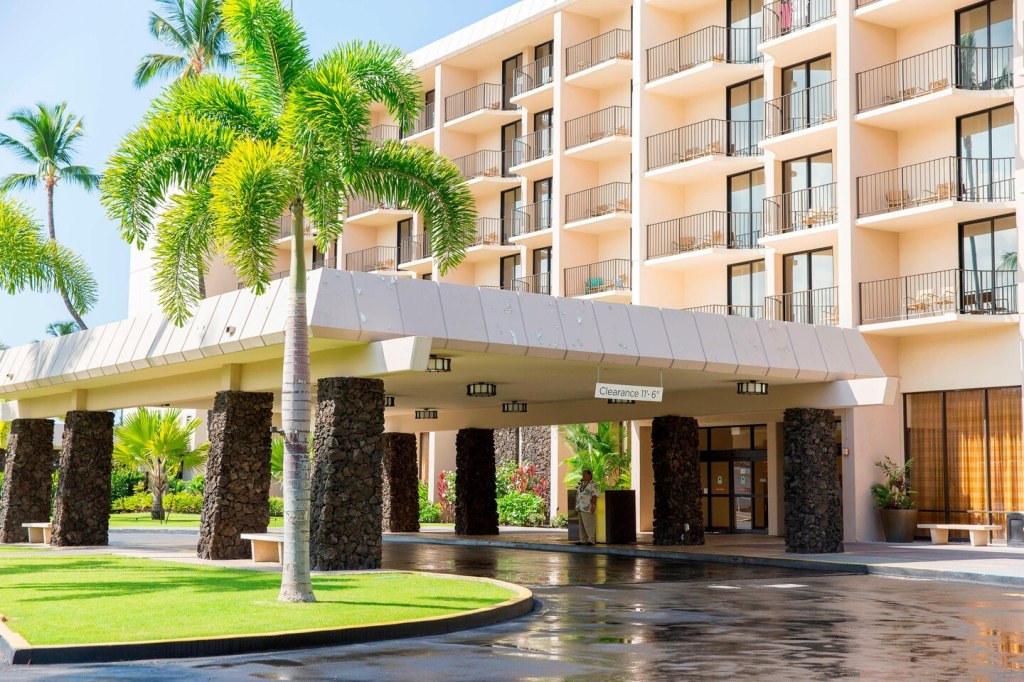
King Kamehameha Marriot Hotel in Kona – front entrance.
We get to the King Kamehameha hotel, right on the shore in the bay, and check in. It is almost midnight, and the lobby is empty. As we are checking in, another couple arrive. They tell us that they were also on our flight. We go up to our room – facing kind of away from the ocean and more towards town, but whatever, we just want to go to bed.
In the morning, we walk through the hotel where they have a display of paintings and a history of Hawaii. Then through an ABC store ( kind of like a corner convenience store similar to a 7-11, but with more tourist souveniers) and out on to the roadway alongside the sea wall at the edge of the bay.
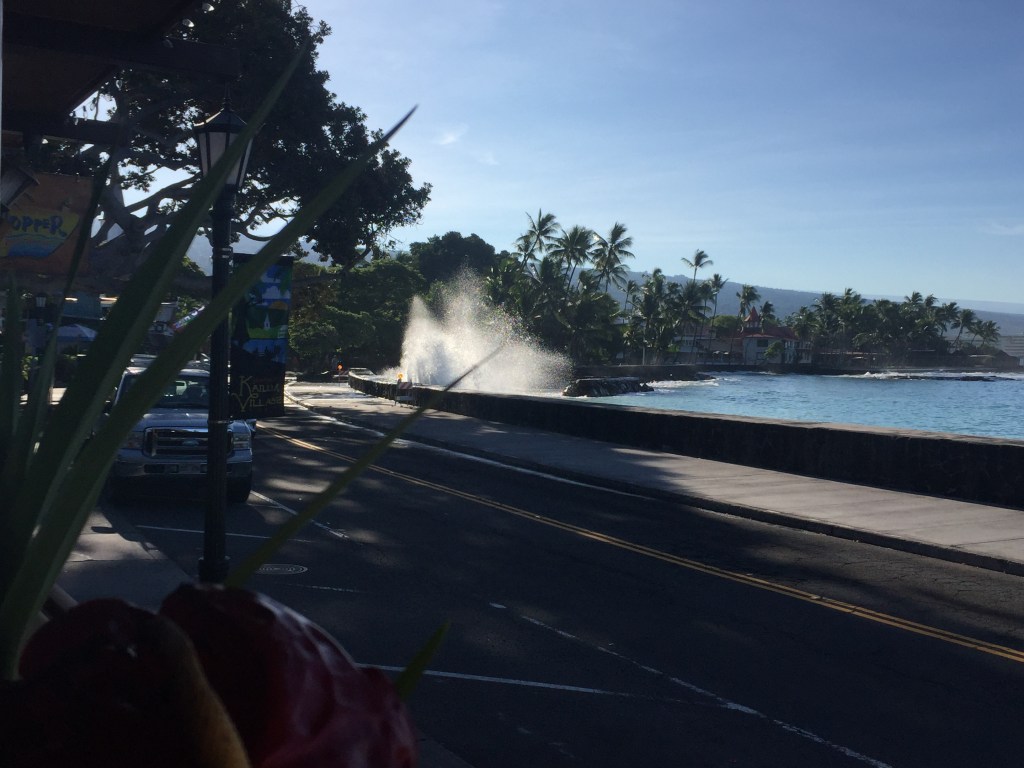
Waves splashing over the sea wall in Kona
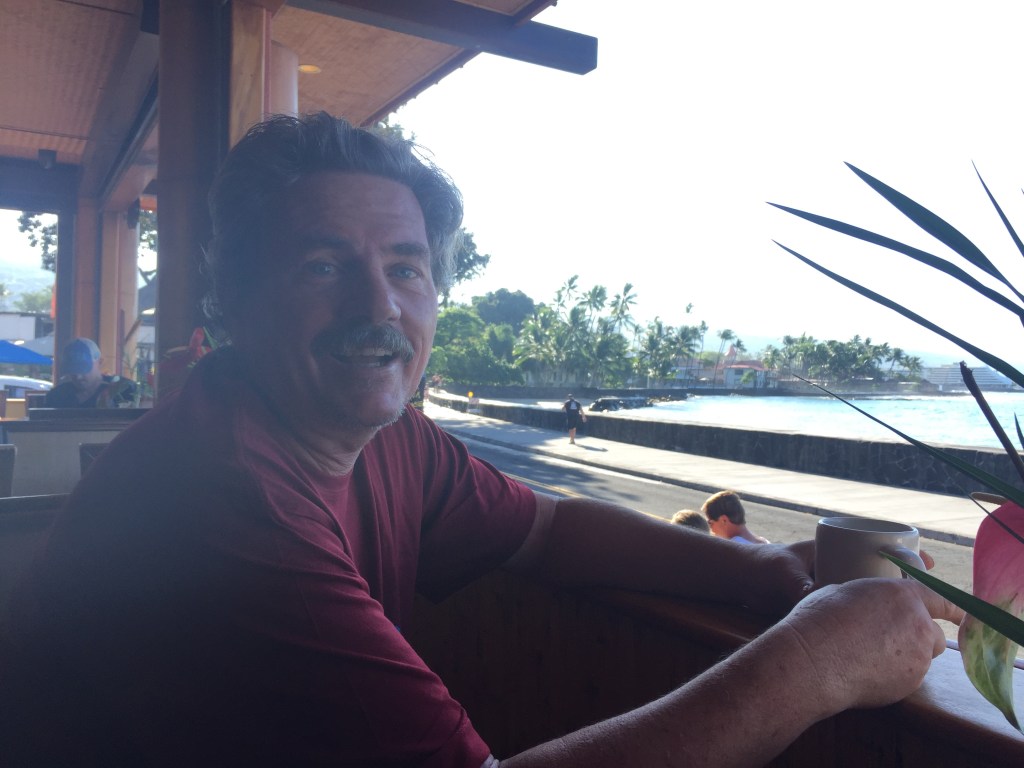
We go down the sidewalk a ways to a restaurant and stop in there to use our meal vouchers for breakfast.
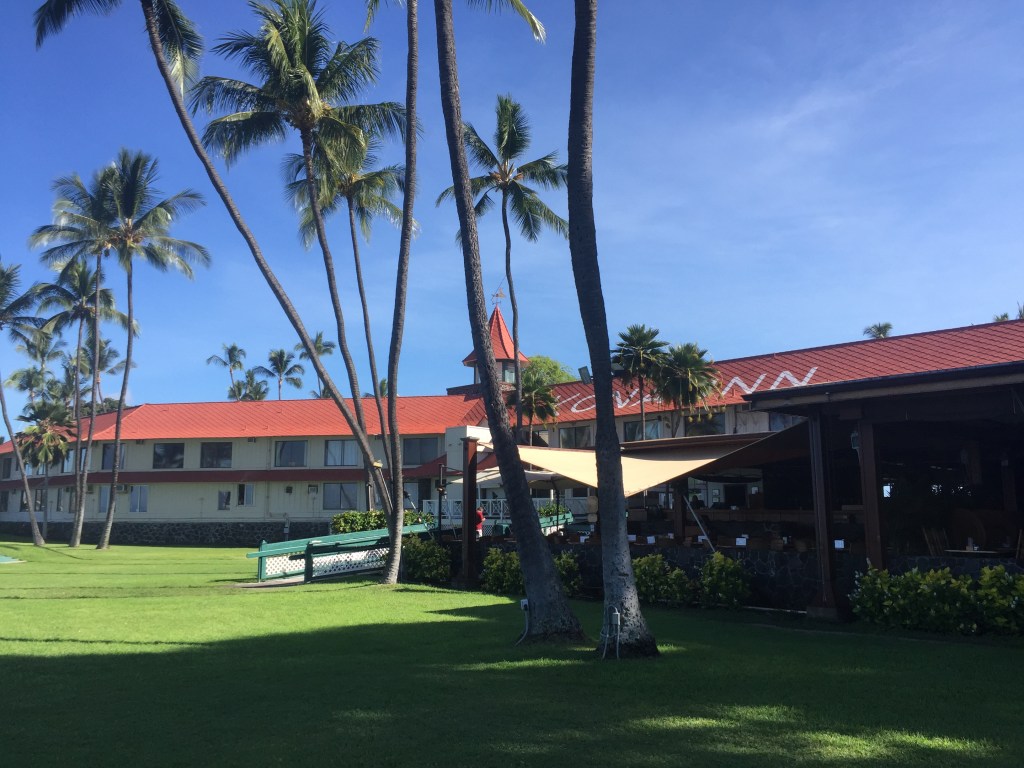
After breakfast, we become tourists and walk along the road next to the shops. Then on down the road past the Kona Inn and then out to the bay at the back of the Inn.
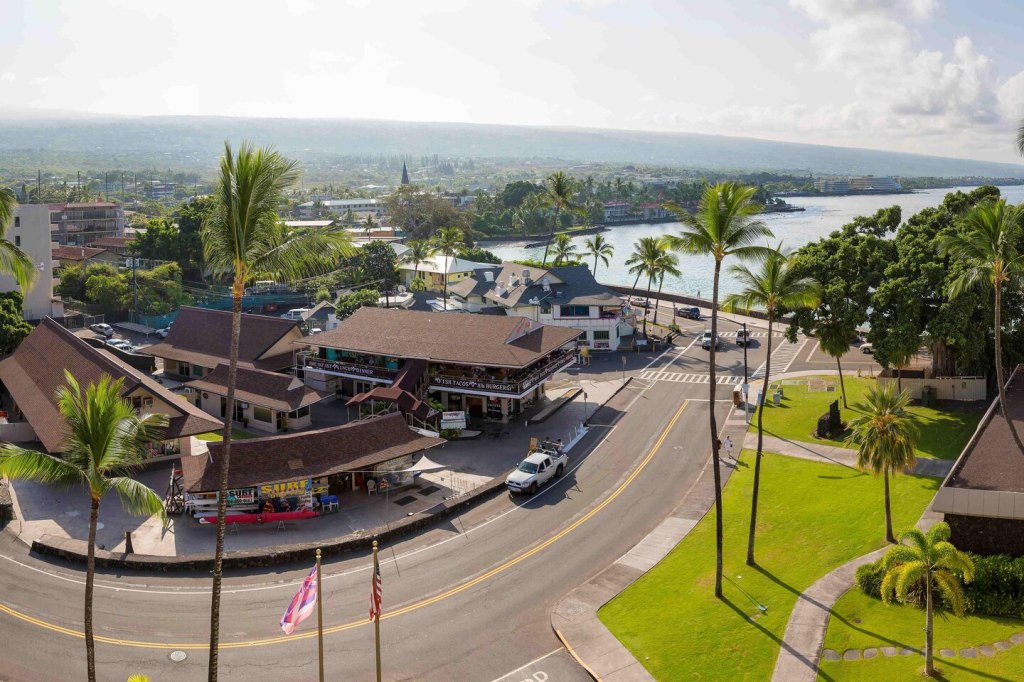
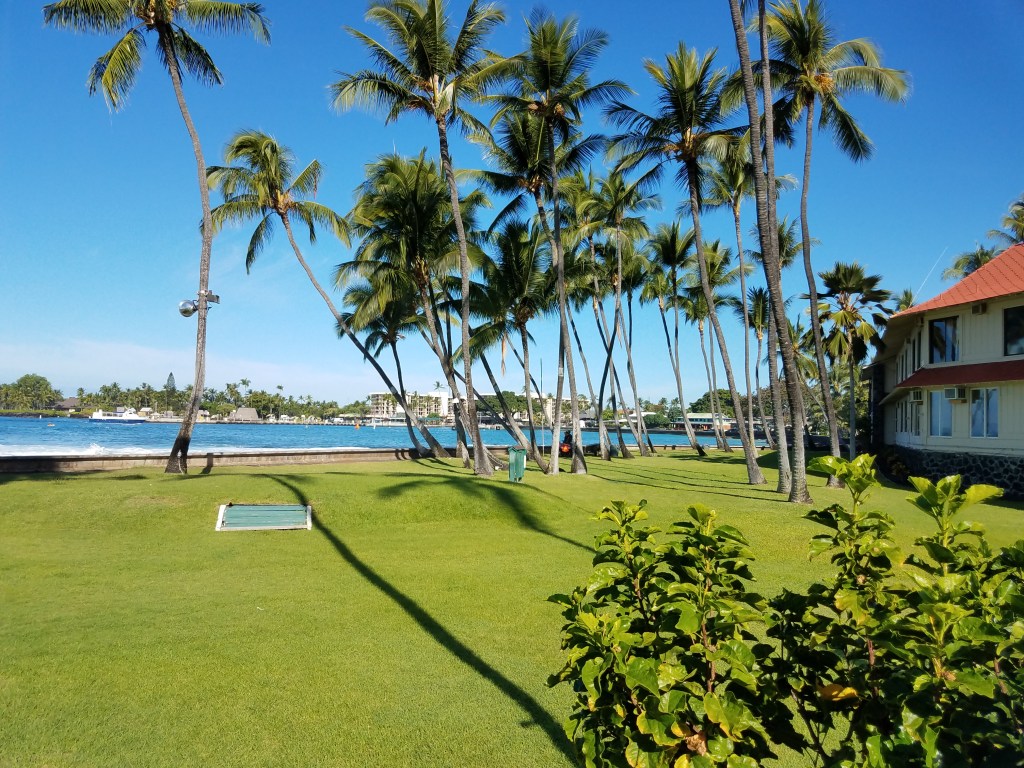
Historic Kona InnLooking across Kailua Bay from the Kona Inn to the Marriot King Kamehameha Hotel
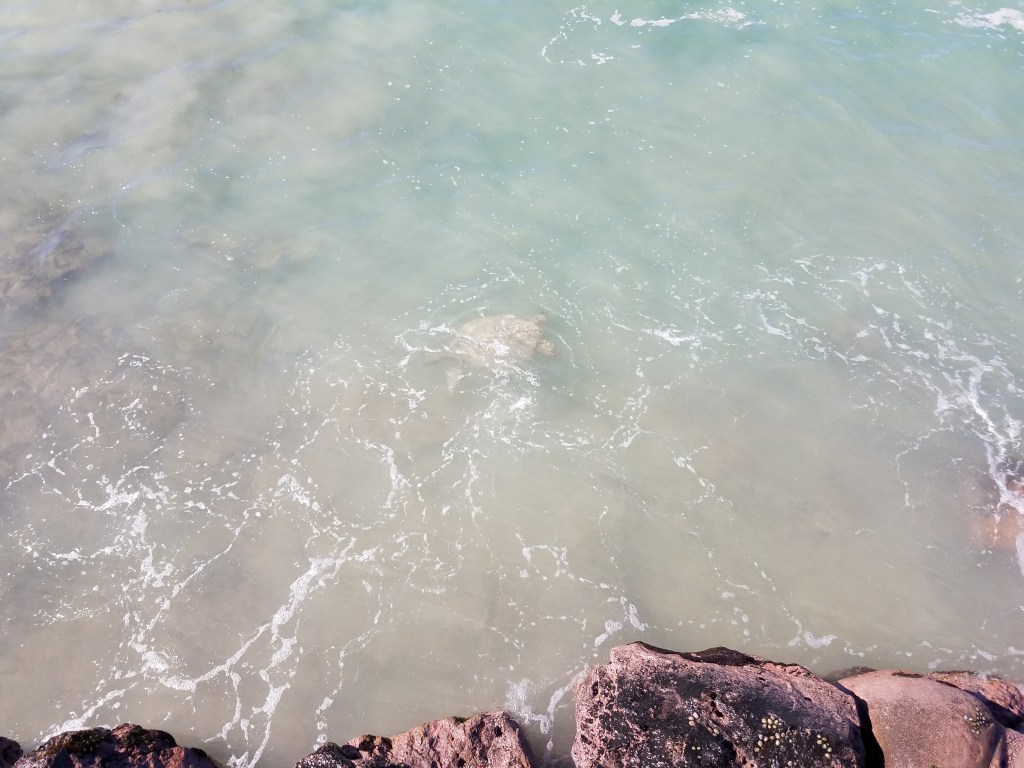
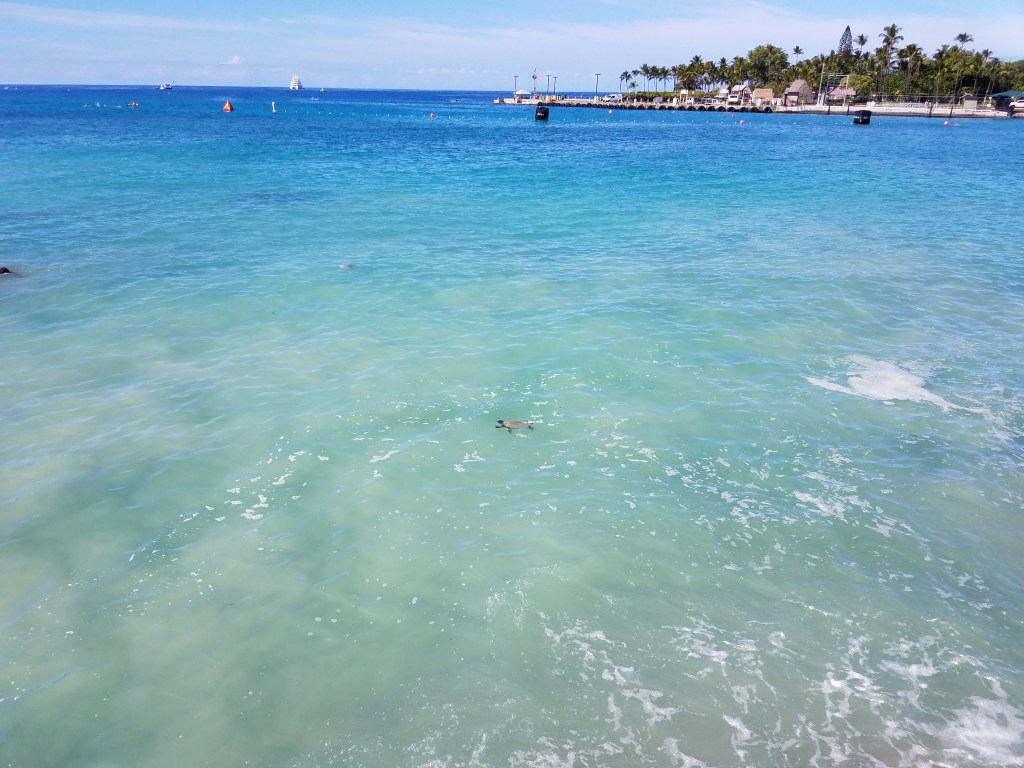
As we head back towards the hotel, we walk along the sea wall with the waves splashing against the wall and spraying over onto the road. I climb up on the wall. Looking down, I see something in the water. It is a large turtle.
Large ocean turtle in Kailua BayTwo turtles
I watch it for a while as it washes back and forth with the waves right next to shore. Then it swims away from shore a ways and I look a bit further out into the bay, and there is another one.
After watching the turtles a while, we go back to the hotel, get our luggage and go back pout to the airport and off we go. Back to the real world.
It was a rush to get to the airport so that I could sit and wait.
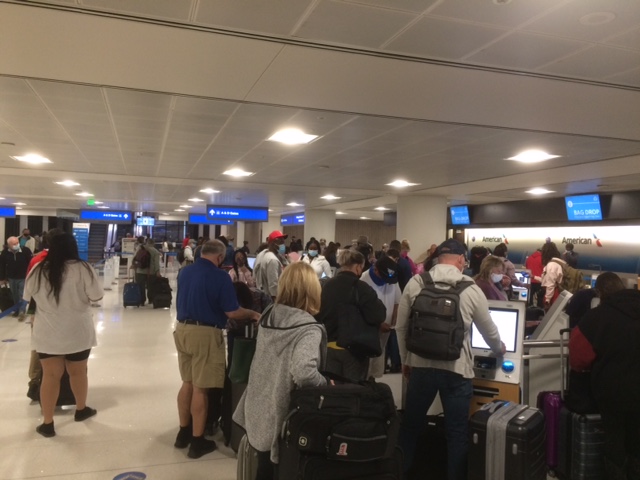
It was a hassle at the check-in kiosk. I thought that the purpose of the kiosks was so that you didn’t have to wait in line. There was a line waiting for the kiosks. I also thought that the purpose of the kiosks was to free up the employees by allowing you to do it all yourself without the employee. There was an employee directing people in how to line up properly, one employee performing IT fixes on the kiosks that were not working properly, and two employees helping people at the kiosks. Maybe if they got rid of the kiosks and put these four people behind a standard check-in counter, there would be enough clerks helping passengers that there would be no line. What a novel idea. The instructions for using the kiosks told you to slide your passport or boarding pass into the machine face down when in reality, you need to hold it under a little red light underneath the slide portion of the machine. Another passenger had to show me this as the employees were all busy doing other things. After printing my checked luggage tag for my one checked bag, the instructions tell you that you are to put the luggage tag on the bag yourself, so that an employee did not need to do this. How? How do I get the paper off the adhesive part so that it will stick together? I had to have an employee do this anyway. Despite the hassles, I got my bag checked in and now I am off to find gate A27.
I go through the security check point. Both my carry on and my “personal item” are pulled aside for additional inspection. When this happened the first few times, I would get worried. Now it is almost a given. The bottle of sugar and the smoked sausages were suspect. I have to admit, who would be taking C and H pure cane sugar from Hawaii, back to Hawaii? Does C and H still exist? I know that they no longer grow sugar in Hawaii, but I thought C and H was based out of California. One of those things that make you go Hmmmm.
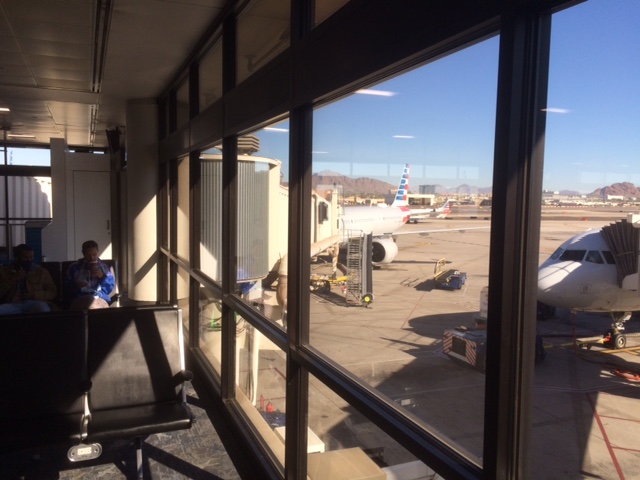
At the gate, I sit and I wait. Gate 27 and Gate 29 share the same seating area. I see a plane sitting at the end of the ramp for gate 27. It does not look very big. I hope that it is just my angle.
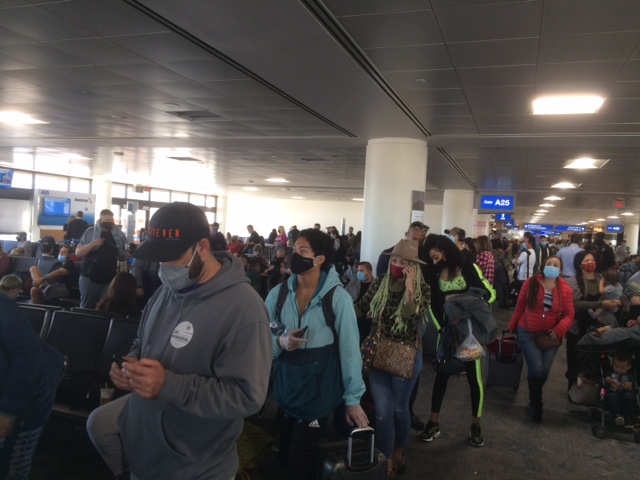
The people for the flight to Miami leaving from Gate 29 line up. The line extends past gate 27 and down the concourse. I wonder about social distancing. They get on their plane.
I sit and I wait. A mechanical voice calls for group 1 for my flight, and about 16 people go through the gate and down the ramp towards the plane. I do not hear them call for group 2, but the call for group 3 attracts 5 people to the gate door. A crowd of 15 to 20 people are standing in a semicircle about 15 feet away from the podium at the gate, waiting. The mechanical voice calls for group 4, and no one moves. These groups are assigned by the airlines when they creat the boarding passes. Surely, they know that there are no people in group 4. But we wait. Group 5 is called and 10 to 12 people go to the podium, scan their boarding passes, go thru the door, and head down the ramp towards the plane. The gate agent leaves the podium and goes into the jetway, closing the door behind her, leaving 4 people standing at the doorway. The group of people grows to around 25 or 30 and crowds closer to the gate door. We wait. A few minutes later, the gate agent returns and scans the boarding passes of 4 people who were waiting at the door. They enter the doorway and go down the ramp as the gate agent returns to her position behind the podium. We wait. She is furiously punching keys on the keyboard of her terminal and the mechanical voice says, “We would like to welcome group 6 to board American Airlines flight 663 to Kona.” Everyone presses forward and I get in line behind 9 or 10 other passengers. It is my turn, and I go to scan my boarding pass on my phone screen and the gate agent informs me that I also need a picture ID. Huh? What? I don’t remember doing that before. Whatever. I stand at the scanner as I put away my phone after scanning my boarding pass. I search for my ID. It is not in my wallet. I find it in my shirt pocket where I put it after printing my luggage tag. I show it to the gate agent and everyone behind me stands and waits. I go down the jetway, and straight on to the plane. It looks empty. I find my seat, and wait. The plane is about 1/3 full when they close the door and start the safety briefing.
The plane leaves the gate, taxi’s to the runway and immediately heads off down the runway! We are off! 6 hours and 27 minutes to Kona!
I sleep.
Somewhere over the Pacific Ocean, I slide up the window shade. The ocean stretches out for miles. There are a few clouds out on the horizon, but as I look down, all I see is water. I wonder what it would be like to be on a sailboat in the middle of all that water for three weeks. We approach the clouds. They look like cotton balls that have been spilled out onto the bathroom floor.
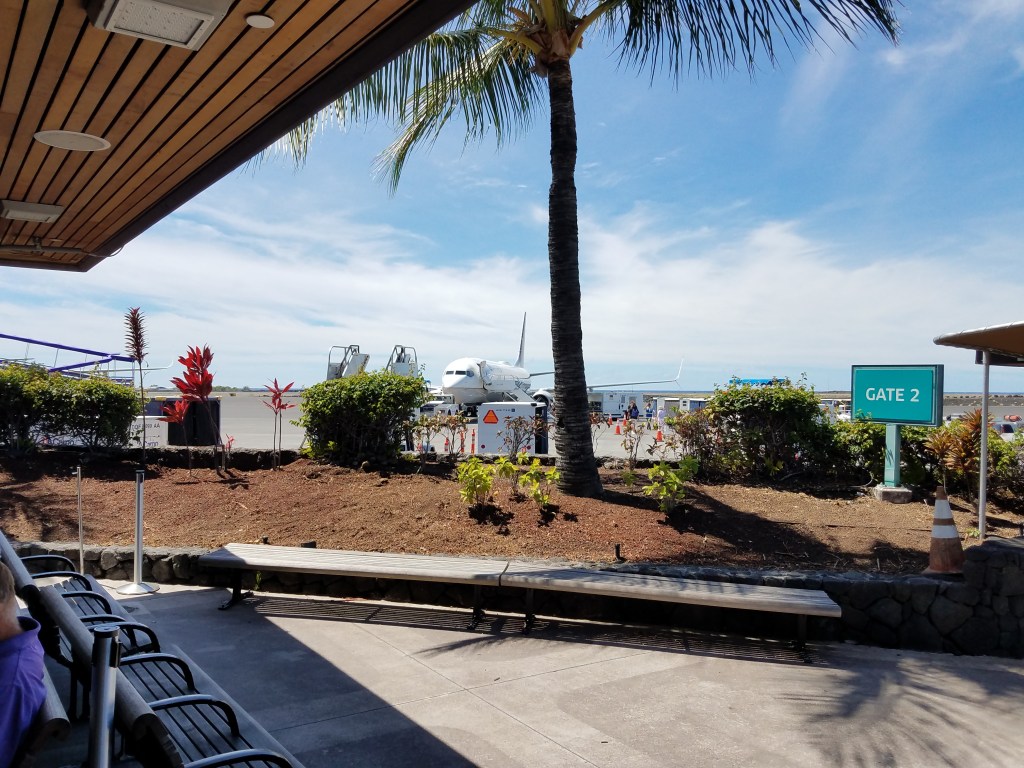
We fly between Maui and the Big Island as we approach Kona, and begin to descend as we fly along the coast of Hawai’i. The landing is soft and smooth and we taxi to the gate. I gather up my cell phone, my book, and stuff them into my backpack and head to the front of the plane. Kona does not have jetways. Getting on and off the planes, you must walk from the gate, across the tarmack to a mobile ramp that leads up to the dooor of the plane. The reverse is true for when you arrive. There are cones that direct passengers to the appropriate gate and don’t just wander around the tarmack. Today, there are a dozen people stationed among the cones “helping” the passengers stay within the boundaries of the cones. Once inside the gates, the terminals appear deserted. There are lanes identified to direct you to certain checkpoints. The first of which is to verify that you have registered on line with the Hawaii Department of Transportation and have received a bar code pattern for you and this trip. It is really quite simple, the form asks you a few questions about your health, and where you are staying and how they can track you – everything short of imbedding an RFID tag under your skin. I had tried to register a week before traveling, but you are supposed to do it within 24 hours so that the information about your health is current. I could not complete it because I was too early and didn’t remember to go back and complete it, so they had people there to assist travelers in completing the form. After getting the bar code, I needed to have it visible on my cell phone so I could show it to the person at the next check point 15 feet away, along with proof of my negative covid-19 test within 72 hours of traveling. I checked out and was free to go on my way.
I passed an area cordoned off with those metal barriers that look like bicycle racks where travelers who did not have proof of their negative test were sent for further processing. What that meant, I do not know.
I went out of the terminal and into the fresh air. The psychological difference was amazing. Inside, while passing through their gauntlet, I felt depressed, oppressed, inferior, suspect, etc, but once out of that environment, I felt truly free.
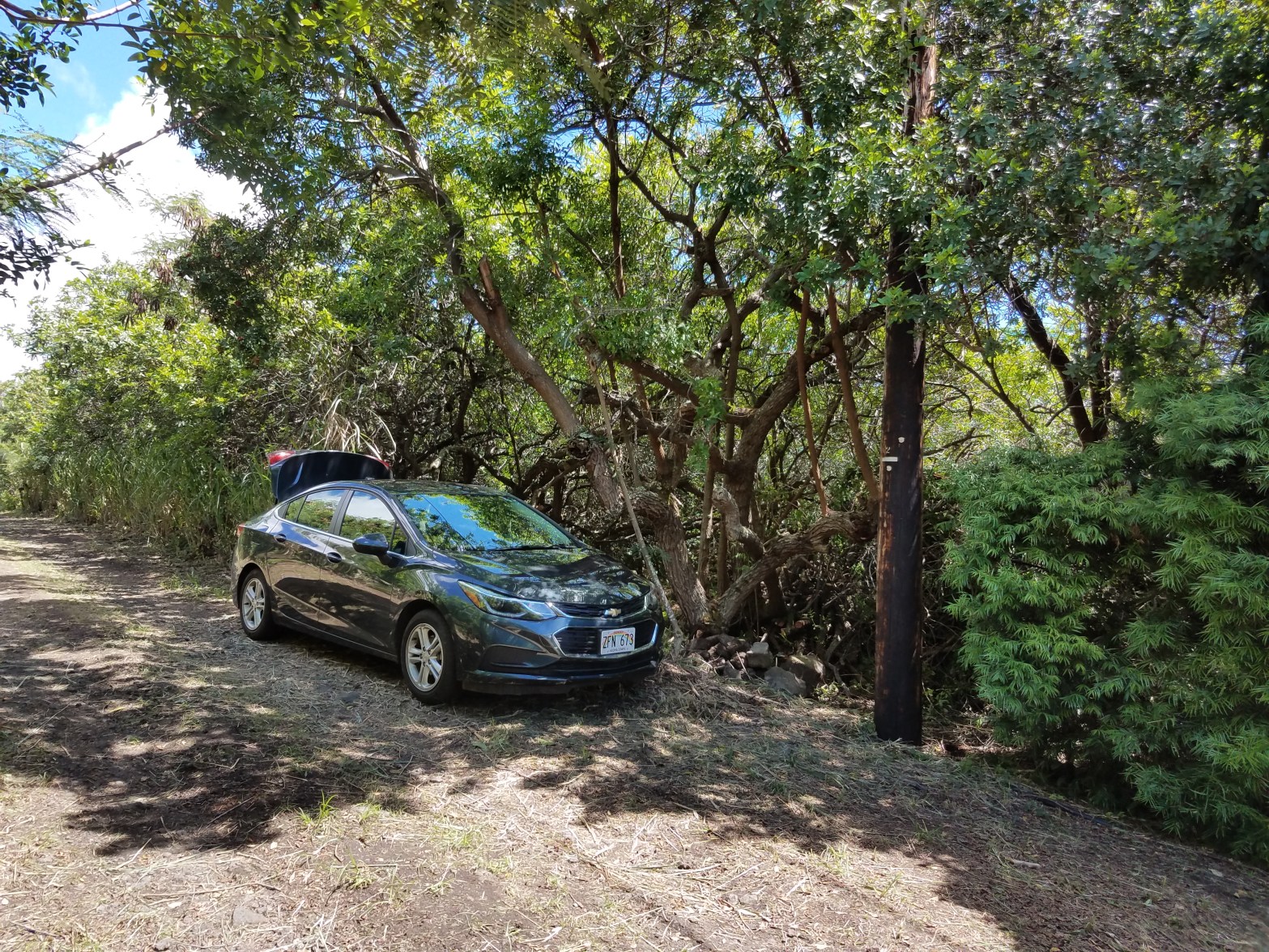
I collectred my checked bag and got on the shuttle to the car rental facility. Check in was relatively quick and easy, and they asked to see the proof of my negative covid test. My car was in space A28 – it was a Chevrolet Malibu. The car in space was not a Chevy Malibu, it was a full size Nissan SUV. Back to the office. “Wait here, sir. I’ll bring up your car to you.”
Through the gate at the street and around the corner to the Highway, and I’m off on another Hawai’i adventure.
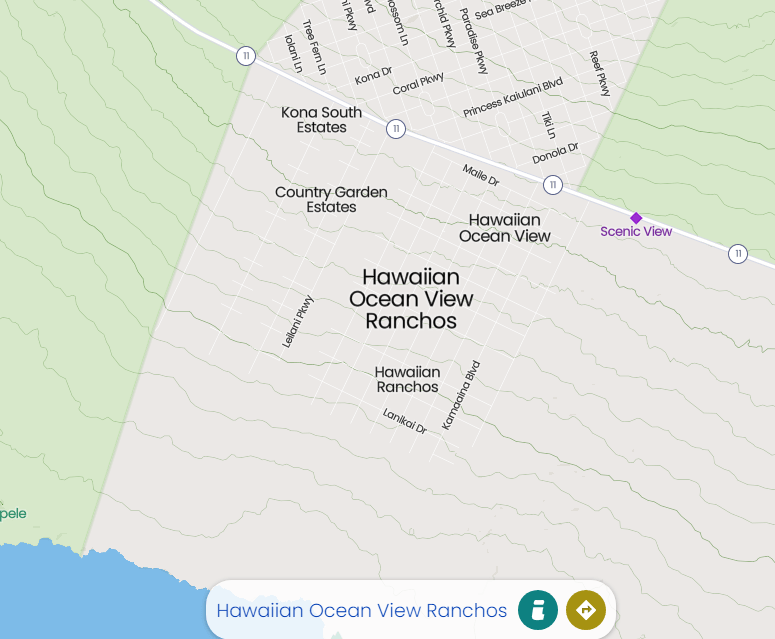
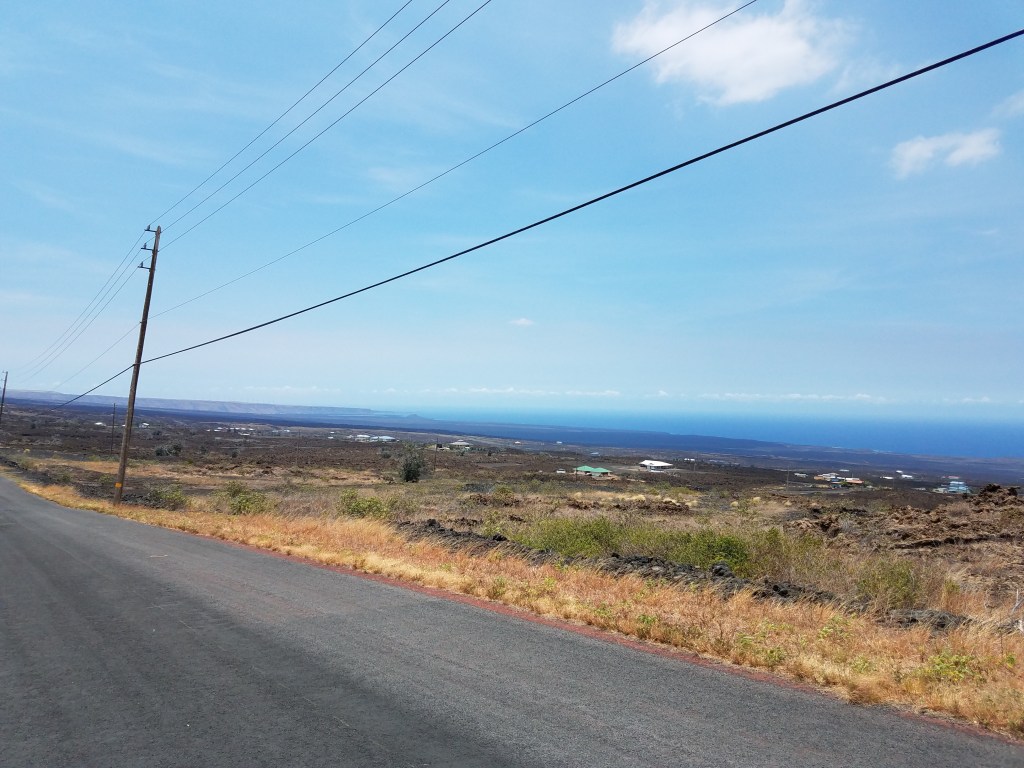
Late in 2017, we made a trip to Kona to continue with our journey towards a vacation home/ retirement home/shack on the beach. We met with a realtor from Hilo and toured some interesting locations. We looked at a three acre parcel north and west of Ocean View Ranchos, a sprawling subdivision in a vast lava field with three acre lots and fantastic ocean views. Unfortunately, the week before we arrived, someone had made an offer on this property and the realtor was not keen on us submitting a backup offer. This lot is about 2 miles below the highway 11 along a rough dirt/gravel/rocky road called Road to the Sea. This road goes all the way down to the ocean, but it requires a 4 wheel drive vehicle further down. Also, this lot does not have a deeded right of way access to it. You would need to cross two other one acre lots to get to it. This lot would require extensive bulldozing to create a building site out of the Aha lava. Not ideal.
We looked at property on the other side of the Volcano National Park, nearer to Hilo in Hawaiian Paradise Park (HPP), Leilani Estates, Hawaiian Acres, and Orchidlands Estates. While these lots and this area is on the wetter side of the island and has more vegetation and jungle, most of these lots have no view of the ocean. Not what we had in mind. An ocean front lot in this area would be so far out of our price range to make it an impossibility.
This brought us back to the subdivision/town called Ocean View. We looked at a couple of lots in the area above the highway, or the mauka side meaning away from the ocean in what is called HOVE or Hawaiian Ocean View Estates. These lots are one acre each and have variety of vegetation/trees. We looked at one home that had a neighboring lot that looked like the city dump. It seemed to us that this was pretty common here.
This led us to the Ranchos which are three acre lots and below the highway, or on the makai side meaning towards the ocean. The terrain of most of these lots is mainly rough lava. Like HOVE, the Ranchos has paved streets and power poles at the streets with electricity and telephone available.
Ocean View Hawaii – The Ranchos
But no water. These lots would all require a catchment system where the rain water is collected from the roof and storred in a tank, Then it is filtered and pumped into the house for use in washing, bathing, landscaping, gardening, maybe cooking, but not for drinking. It would require additional purification like boiling before it would be suitable for drinking. This area of Hawaii gets an average of 2″ of rain per month. Some months, more, some months less. In the months when there is little to no rain, people would have water delivered in large tanker trucks, much like I saw them doing in Rocky Point Mexico. Two inches of rain is not a lot of water, but there are many homes in this subdivision that seem to be able to get by with this system. There are even a couple of homes here with swimming pools, however, most every home has very limited landscaping.
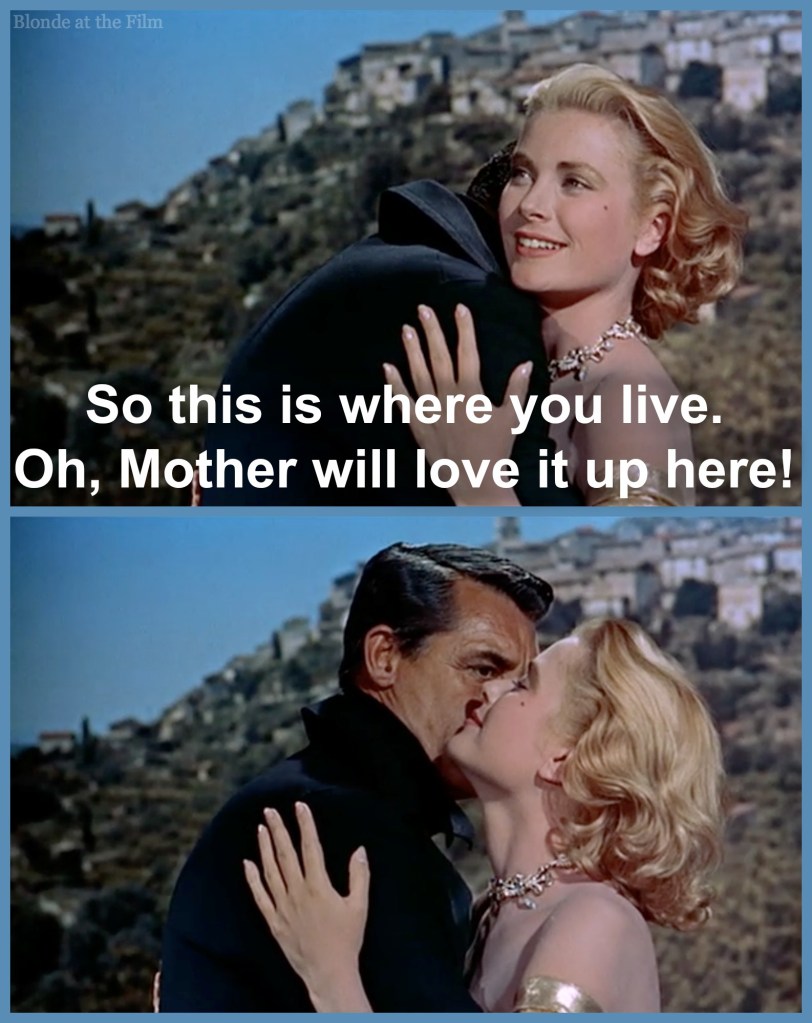
What I find appealing about Ocean View – both parts, the upper section as well and especially the Ranchos – is the view. Most every lot has a fantastic ocean view. And that is what I am looking for. I keep picturing in my mind, the home where John Robie (aka Cary Grant) lives in the 1955 movie “To Catch a Thief” with Grace Kelly.
John Robie’s VillaLunch with John Robie from Alfred Hitchcock’s “To Castch a Thief”“Mother will just love it up here” from Alfred Hitchcock’s “To Catch a Thief
We made an offer on a lot down in the lower sections of the subdivision and returned to the main land to wait for the response. I didn’t offer full price, but I did offer cash. The seller said no. He wanted full price and cash. No counter offer. Just full cash pricing. Kind of put me off. I’m not sure if I was relieved or disappointed, but I decided to look a little further and went back onto the internet , located a few more likely candidates, and booked tickets to return to the Island. . . but for more reason than just looking at property.
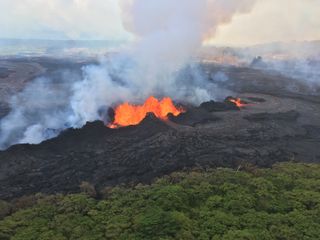
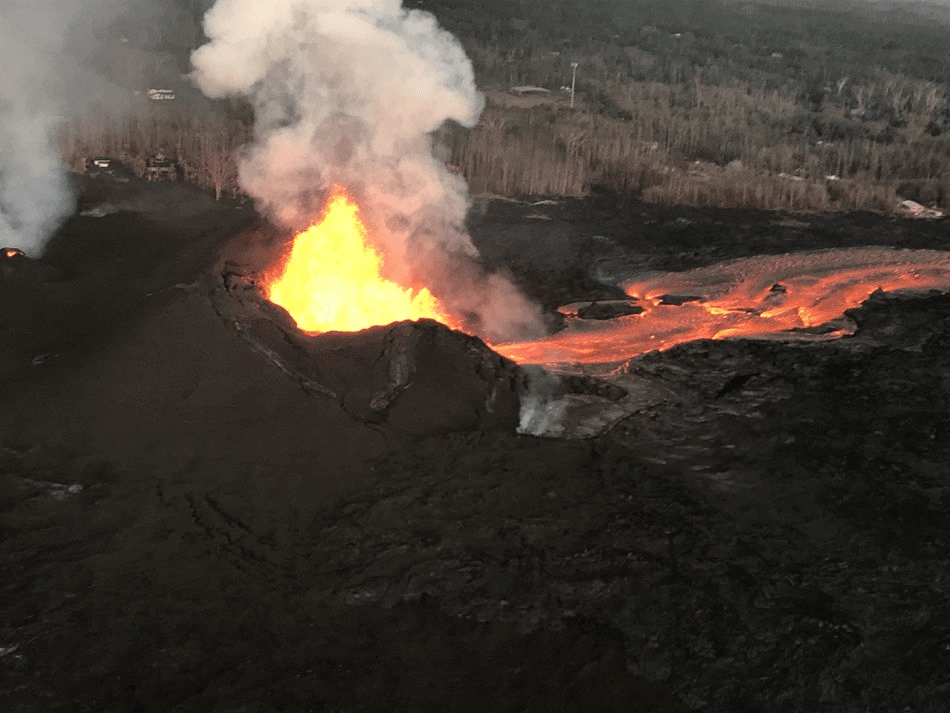
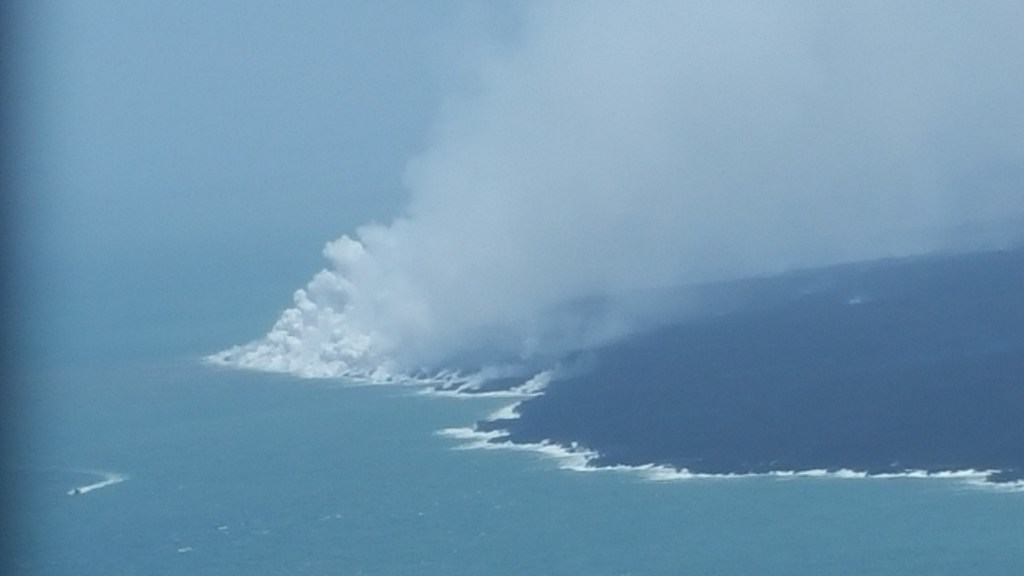
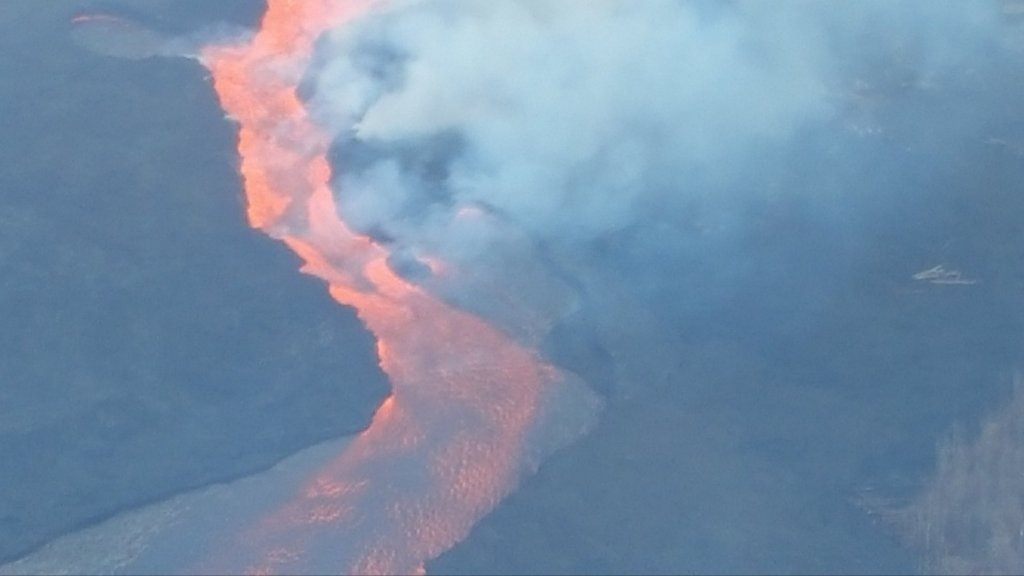
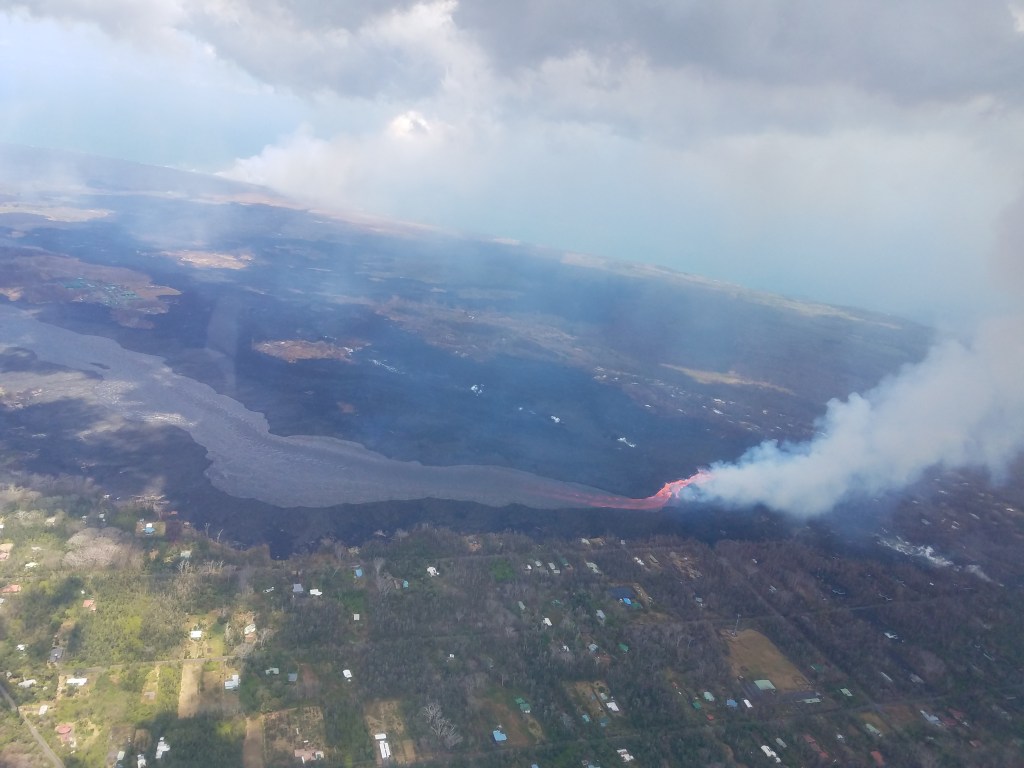
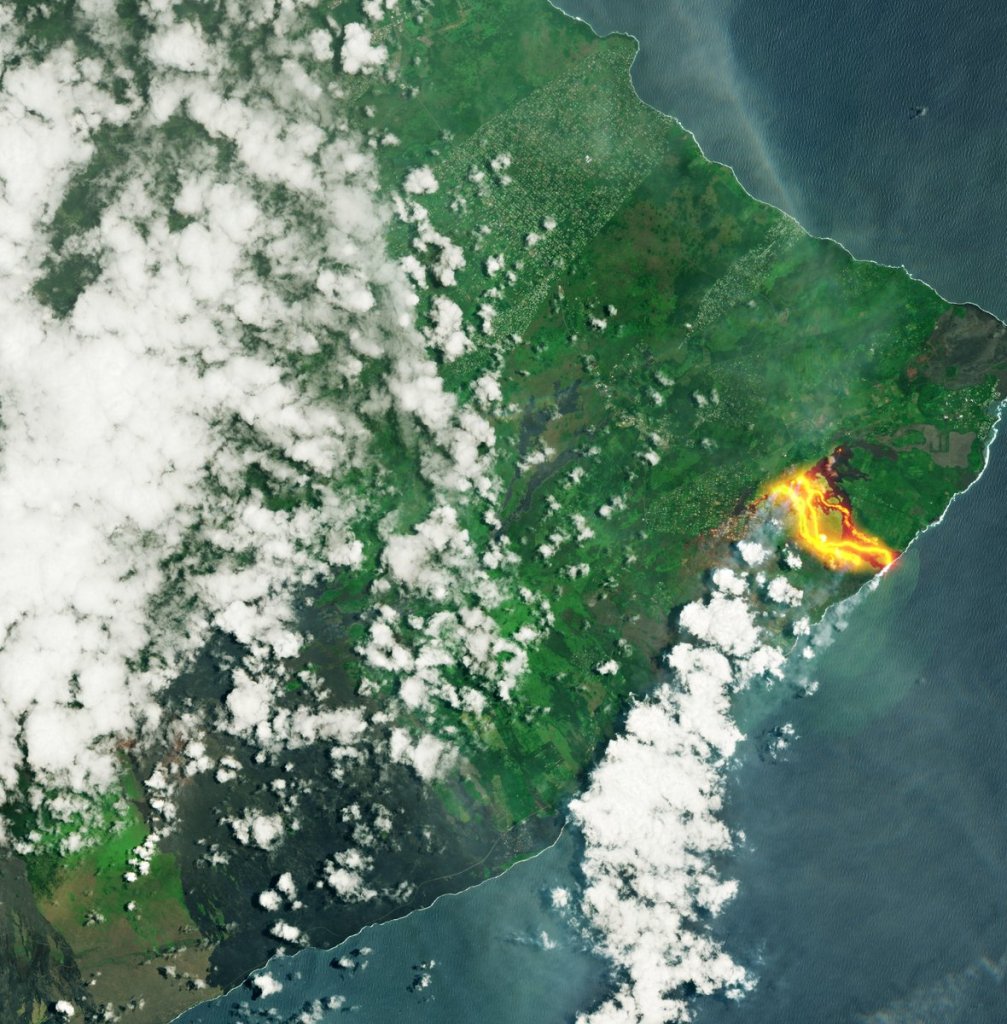
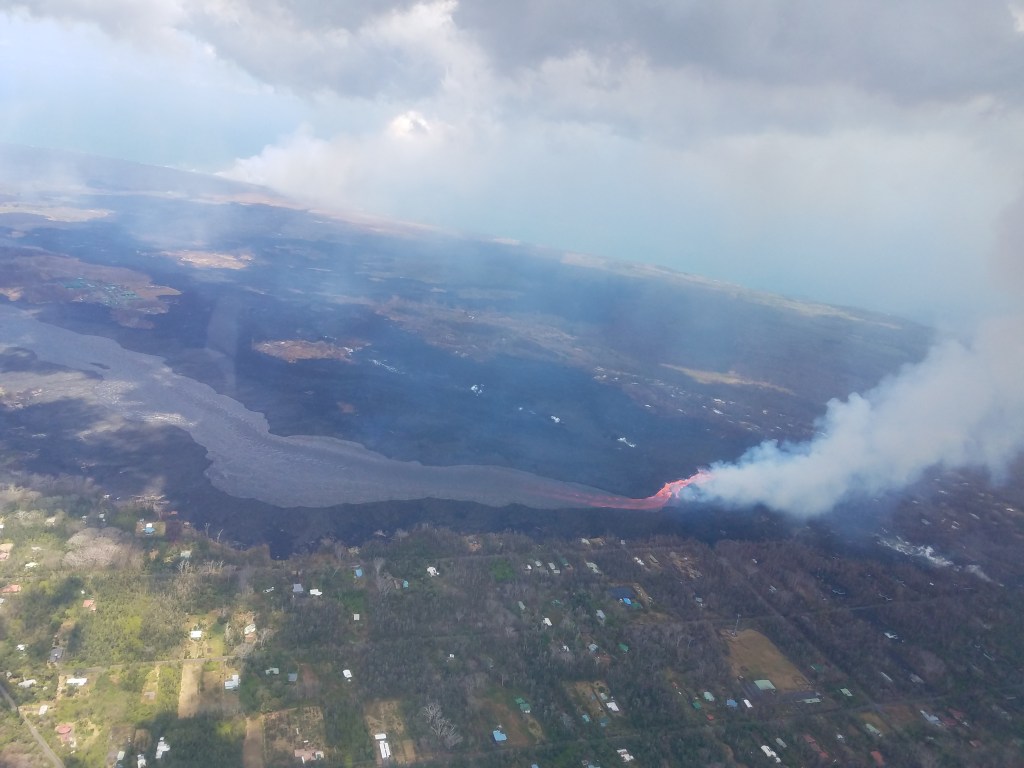
Kileaua is one of the most active volcanos on earth. The home of Pele, the Goddess of Fire, Kileauea has been continuously erupting from 1983 to 2018. In May of 2018, Kileauea opened up on what is known as the East Rift Zone with numerous fissures opening up. A yer or so ago, there was lava flowing through the forest in this same area towards the town of Pahoa when it stopped. This time, the lava came up in the backyards of many people in the Lailani Estates subdivision creating a new lava cone some 300 feet high with a river of molten lava flowing to the ocean hundreds of yards wide .
We decided that we might never get a better chance to witness a volcano erupting, so we booked tickets and returned to the big island in July.
How do you find a doctor on the far south end of the big island of Hawaii? One that is on your Arizona health insurance network? On a Saturday morning?
Phone calls to the 800 number of the health insurance network go to an automated recording . . . “Our office hours are Monday thru Friday between the hours of 9:00 AM and 4:30 PM Eastern Standard Time. If you are calling outside these hours, please call back during regular office hours. If this is a medical emergency, hang up and dial 911.” Well, that’s no good! A search online for an urgent care center nearby yields a phone number for a Nurse Practitioner in Waiohinu who does not answer. Hmmmm! Well, I know that there is a hospital in Hilo. Also, there are a couple of urgent care centers in Hilo according to our internet search. Hilo is closer than Kona – time wise – so it is into the car and off we go.
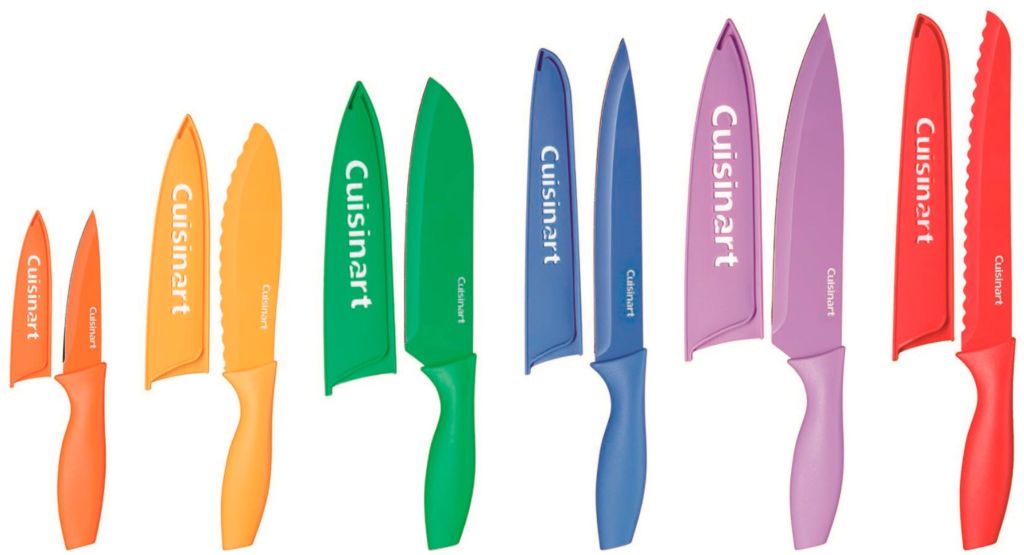
Alanah has sliced her thumb pretty badly. While fixing breakfast, she got a knife out of the cabinet drawer in the kitchen. These knives have a cover over the blade to keep them sharp when they are in the drawer and so that you don’t accidentally cut yourself.
Not realizing that the cover was already off, because the blade is the same color as the cover, she grabbed the handle with one hand and what she thought was the cover with the other hand and pulled the knife out of the cover. . . only, there was no cover, and the knife sliced deeply into her thumb.
We drive through Na’alehu, and past Whittington Beach Park. We go past Punaluu Black Sand Beach and past the town of Pahala. Not knowing what is in Pahala, we didn’t think it wise to go cruising around a strange town hoping to find an urgent care center, so we passed by Pahala and headed up the road towards Hilo when Alanah’s phone rang. It was the host we were renting the house from. They just wanted to check that we found everything and that everything was OK. Well, . . . actually, . . . things aren’t OK. Alanah proceeded to tell her about slicing her thumb, and that we were headed in to Hilo to the hospital or an urgent care center. She said; “Don’t go to Hilo. There’s a hospital in Pahala.” So, we turn around and go back to Pahala. Sure enough, right there just off the highway is the hospital. We walk in and about fifteen minutes later, Alanah is getting her thumb stitched up.
She needs to keep it dry for the next week or so. The nurse gives her a bunch of those plastic gloves, some clean gauze, a roll of white tape, even the small scissors the doctor used. “We just have to throw it all away anyway,” she says. We finalize the paperwork and we’re out the door.
We arrive at the property around noon and begin cutting and trimming the christmas berry trees – trying to create a path in. The next door neighbor’s little dog is sitting on his porch barking. And barking. And barking. After about an hour, a woman walks up the road. “Good morning”, I said. And then correct myself, “or afternoon.”
She timidly replies “Hello”. But I can tell there is more she wants to say, but doesn’t want to be rude.
Alanah speaks up, “We’re trimming up our property.” From the startled look on her face, I wondered what she thought we were doing. We put down the clippers and the tree saw and came out onto the road towards her to intoroduce ourselves. “Hi, I’m Alanah.” my wife says. “I’m David” I add.
Our neighbor next door, Lorenzo walks up the road ang joins us.
Lorenzo and Pua
“I’m Pua” she replies. I must have given her a questioning look so she quickly adds, “like the flower”.
We exchanged the typical neighborly formalities of small talk – where we are from, where she lives, etc,. and she asks,”You bought this place?”
“Yes”, I replied. “We bought these two lots last month and have come over to see what it is that we have bought.”
“You aren’t going to spray, are you?” she asks.
Not knowing what she is referring to, I just say no. After exchanging the typical, “Well, it was nice to meet you” greetings, she turns and leaves and comments to herself, but out loud, “I’ll have to record you on the roster.” ????? What roster? She proceeds back down the road in the direction she came from and stops at the neighbor, Lorenzo’s, gate to chat with him. I’ll have to tell you about Lorenzo in a different post.
We flew United Airlines from Phoenix to Los Angeles. Then changed planes and continued on to Kona. We left Phoenix at 10:45 AM and arrived in Kona at 7:50 PM. There was a great sunset view from the plane as we crossed the Pacific Ocean above the clouds.
We picked up a rental car at Thrifty Car Rental which we had booked on line a couple of weeks ago. The car rental agencies are all located within walking distance of the terminals, but they still provide shuttle busses to pick you up from just outside the baggage claim area to their lot – less than 1/4 mile away. That was a good thing, because it was dark.
We drove to WalMart and did some grocery shopping because the best information we had was that there were not any grocery stores down near South Point and You needed to get your groceries before leaving Kona. The next stop was Home Depot to pick up some tools – a hammer, prybar, a shovel, 2 large pruning shears, a small hand shear, two folding tree saws, some closethline rope. We had come to start work.
The last time we were here, we had purchased two lots in the Mark Twain Estates subdivision outside of Na’alehu, next to the Discovery Harbor subdivision.
Currently, they were covered in a tangle of jungle – mostly what they call christmas berry trees some 25 or 30 foot tall. Our objective was to try to tame this jungle and try to get an idea of what it is that we have bought.
We drove to the Green Sands subdivision which is located between Mark Twain Estates and the town of Na’alehu. There are a couple of hundred lots with a mixture of paved and dirt roads. Each lot is about a third of an acre, and they have electricity available on power poles at the street in front of each lot. We had booked a week at a house in this subdivision through Air-B-n-B. The directions were fairly easy and we found the house relatively easily. It is a two story house, or maybe I should say it is a single level that is up on stilts 10 foot tall, with an exterior starcase and the area under the house is enclosed for storage. The house is approximately 24 by 30 and has one bedroom, a bathroom, a living room and a full kitchen. This will serve nicely for the week ahead.
It is after 10 PM – which to us is more like 2 AM in the morning. As Garth McCann would say – We’ve had a full day – even if we haven’t been chasing after lions or fighting with teenagers! https://www.rottentomatoes.com/m/secondhand_lions
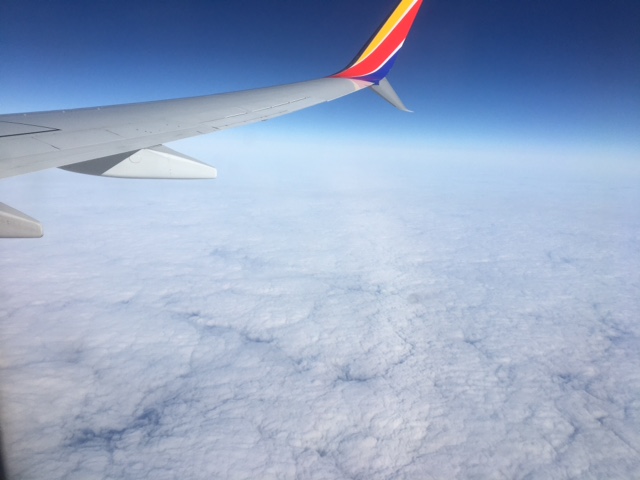
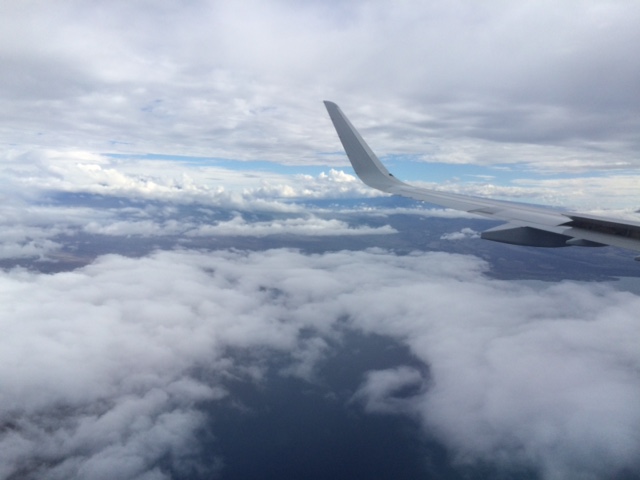
As I look out the window, the only thing I can see is the ocean. And the wing of the plane, of course. There is a thin layer of clouds toward the horizon and below us, but looking directly down (as well as I can through the window of a plane) the water below us looks calm and blue.
The ocean looks calm from 40,000 feet up
We left Oakland behind about ten minutes ago just as most people were starting their day. Mine started around 3:38 this morning. For some reason, the alarm clock decided to sleep in and didn’t go off at 3:00 like it was supposed to, so I had to rush. The taxi I had arrainged for is early and waiting- but he’s not blowing his horn. I jump in the shower, brush my teeth, and throw the last few items into my carry on bag and head out the door. It is now 4:05 AM. Still ten minutes earlier than I had scheduled for the Taxi.
The drver’s name is Robert – I would guess he is in his late 30’s or early 40’s. He tells me that he lives in the Phillipines 6 months out of the year and drives a taxi in Phoenix the other 6 months – which pays for the 6 months in the Phillipines. He has a buddy who has a 30 foot sailboat in San Diego and is planning on sailing to Hawaii in about a year. He mentioned this because he saw my sailboat in the RV driveway on the side of the house. He does not like all the development along Tempe Town Lake, but what can you do? He thinks that all the buildings have ruined the view. I didn’t ask what view is he referring to? The things that taxi drivers talk about on a ten minute ride to the airport!
There is no line at the TSA check point at the airport, but they have a new x-ray machine. It uses larger plastic trays and everything goes into a tray. No need to remove anything like your laptop from your luggage. But you still have to remove your shoes.
Both of my carry on bags – OK, my carry on bag and my “personal item” – were shuttled to the side for further checking. The new machine cannot see thru the aluminum inner lining of the cooler bag that has my cheese and sandwich meat. It also cannot tell the difference between a bag of rice and a bag of whatever white substance might be in a bag the size of a 2 pound bag of rice.
I slept on most of the flight from Phoenix to Oakland. We left Phoenix around 5:30 AM and arrived in Oakland at 6:30. It was a two hour flight, and California is one hour behind Arizona – at least, it is at this time of year.
My flight from Oakland to Kona left at about 8:00 AM. As we were boarding, there were maybe a dozen families with small children getting on the same flight. I was not looking forward to lots of crying and screaming in the near future! As I board, all the window seats in the first 15 or 20 rows are occupied – I am flying Southwest Airlines where they do not assign seats – so I move on back. At row 20, I see an open overhead bin and put my roller bag into the overhead compartment, but I take my back pack with me to row 25. I place my backpack in the overhead bin and sit in seat “25F” – the window seat.
I am joined a short time later by an elderly couple who appear to be in their late 70’s or early 80’s – Earl and Sally. I ask Earl, “So are you two on your honeymoon?” He smiles and chuckles. He tells me that they are headed to Kona on vacation. He asks where I’m headed, and I tell him a little about the property and the work ahead of me to tame the jungle. We talk a bit about Hawaii and of course, Pearl Harbor. He was in the Navy and was stationed at Pearl for a while. I didn’t mention about my Dad being at Pearl towards the end of WWII. He told me that they had recently been to Alaska. He was not as impressed with the whales and glaciers as Sally was, but “it was still nice” he adds. He said that when they returned home to Pittsburgh, he heard someone on the radio saying that it was colder in Pittsburgh that day than it was in Anchorage.
We are at 36,000 to 40,000 feet and about half way down to the ocean is a layer of white fluffy clouds like cotton balls.
There are a few openings in the clouds directly below us where I can see the ocean, but off towards the horizon, it is a thick blanket. The clouds are still gathered and bunched at the horizon. As I gaze at the later below, I follow them to the north. It appears that the clouds rise up and extend to the 40,000 feet elevation we are at – I wonder if that is some kind of ocean storm gathering there. About an hour before we arrive in Kona, the clouds below us clear away and I can see the blue ocean. This is one big ocean!
The flight attendants have passed out the mandatory agriculture forms. One per family. You are to fill them out declaring if you are bringing any agricultural items – fruits, vegetables, plants, seeds, soil, etc. – with you. They collect these forms and the airline turns them in upon arrival. I wonder what the final destination is for these forms. Do they actually find their way to the Hawaii Dept of Agriculture? What do they do with them? With the vast number of people who come to Hawaii, there must be hundreds or thousands of these each month. Does someone do something with them? Collect the data and enter it into a conmputer? You are led to believe that if you bring something in and don’t declare it on the form, they will throw you in prison for the rest of your life, but I have yet to have anyone question me about them. I think that they just throw them into a bunch of cardboard boxes and then turn them into toilet paper. The number of these forms that they would get would require numerous data entry clerks, file clerks, along with the requisite supervisors, and acres of storage cabinets . I just don’t see the value of these forms other than as a deterrent with an empty threat. However, we ARE talking about government here, and government exists to spend money. I believe that they do this to provide the illusion that they are doing something worthwhile to protect the environment off Hawaii.
View of Haleakala Volcano from the plane as we head into Kona.
As we approached Hawaii, we flew over the SE corner of Maui, and over the channel that separates Maui and the Big Island. It was interesting to note that in the channel, there were white caps on the waves, but once past the channel to the south of Maui and to the west of Hawai’i, the ocean was flat and blue for as far as I could see out to the west – with no white caps disturbing the surface.
The plane banks to the left and we descend into the airport at Kona with Hualalai volcano off to the left. A soft landing and I have returned.
One of my favorite spots to spend a few hours in the afternoon is along the shore line to the east of Whittington Pier. Whittington Pier is an old pier that has long been abandoned Also known as Honuapu, this was once the site of a busy sugar cane center with a huge pier that extended out into the bay. All that remains of the pier today is a rusted concrete skeleton that is battered by the waves. A tsunami in 1946 destroyed the pier which had been abandoned after the sugar industry ended in the late 1930’s. The area was turned into a park in the 1950’s
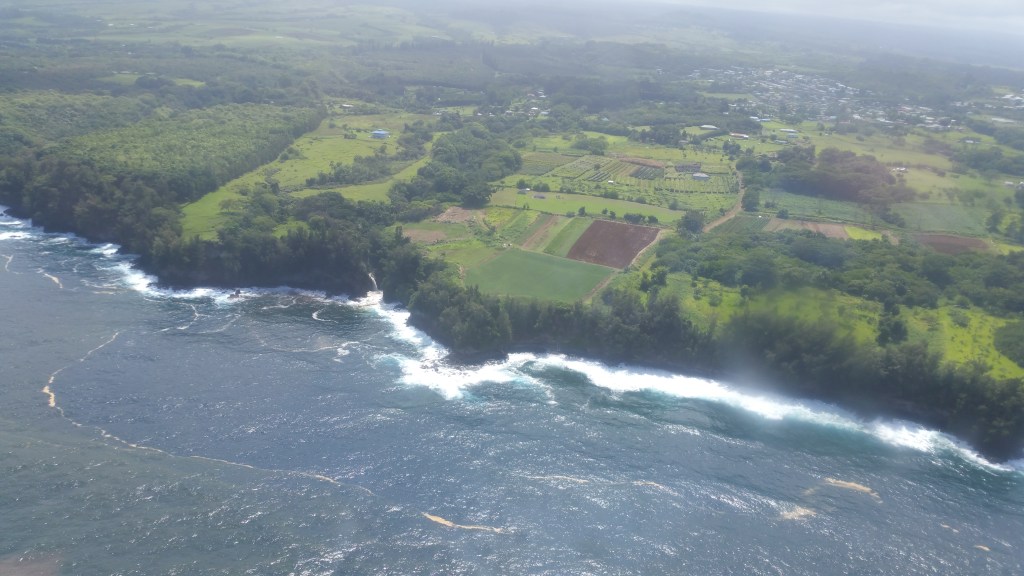
East of the park the shoreline is mainly short rocky cliffs which the waves crash against creating fantastic displays of water splashing high into the air. If you are too close to the shore when one of these waves come crashing, not only will you get drenched, but the force might just drag you out into the ocean. If you do, there is little chance of you being able to get out.
I was sitting under a tree watching these waves come crashing ashore, when a little brown sparrow came flying up to the edge of the shade from the tree. He lands on the green and black sand about 5 feet away with what appears to be a barbeque flavored potato chip in his beak. (her beak? – could have been). The bird looks up at me and studies me for a moment or two, decides that I’m not an immediate threat and bites down on the chip. Most of the potato chip falls to the ground in pieces while the little bird continues chewing. He reaches down and picks up a piece of the chip in his beak and bites down again, and then chews. Then he takes another bite and chews. Then he opens his beak as if he has a piece of the chip stuck in his throat and is trying to dislodge it. But he just stands there with his beak wide open. Maybe the barbeque flavor is getting to him and he is trying to “cool off” his throat. He looks around as if to say, “Anyone got a drink of water?”
After a moment or two, he returns to the potato chip and repeats the entire process. He does this until he has picked up all the pieces of the chip. Then he flies away.
A few minutes later, he returns to the same spot and begins sifting through the sand with his beak looking for any missed crumbs. He looks at me, and cocks his head sideways. Then flies away.
This pandemic is crazy. Maybe it’s just the people, but this is driving me up a wall.
If the government thinks that someone has been killed, they cannot just start locking up everyone. They have to be sure that they are locking up the correct person, and they have to have a warrant from a judge, etc. With Covid-19, they have essentially locked up everyone without due process. We are all locked up in house arrest.
Here is a chart of the top 5 causes of death in Australia.
Compare that with the covid-19 statistics:
They have a population of
There have been a total of 26,651 Covid cases in Australia as reported on Sept 13, 2020That means that one tenth of one percent of the population has even contracted this disease and they have had 810 people die – that is .00257% of the population. So everyone is locked up in their homes and they have to report their movements to the government. They have to ask permission from the Federal Government to leave the country- and most requests have been denied. This is to protect the citizens of Australia from the spread of Covid. How does stopping someone from leaving protect the population from the spread of covid? When someone leaves, they take their diseases that they are carrying with them,
In 2018, Australia had 8,586 people die of Lung Cancer, (the third leading cause of death in Australia) and yet, cigarettes are still available to be purchased. That should tell you how much the Australian /government is interested in protecting the health of the citizens. It’s all about control. Control through fear! Covid-19 does not even come close to making the list of the top causes of death.
What is scary, is that the majority of people in Australia, support this madness!
For the past ten years or more, we have been going to different locations looking for that perfect place for a beach getaway. Well, we still have not found it, but we bought two 1/2 acre lots in Hawaii a year and a half ago.
We traveled to Mexico – Rocky Point (Puerto Penasco), Cabo San Lucas, Mazatlan, Ensenada, and the Yucatan. We went to Aruba, to the Bahamas twice, Florida, California, Fiji twice, and Australia many times. Everything was just too expensive. We went to Kauai, and every morning at around 9 am, a little rain cloud came in from the ocean and rained for maybe five or ten minutes – a very light rain shower – and then moved off. It wasn’t until we had spent a week there that we figured out why. Prices on Kauai are so high, that not even Mother Nature can afford to stay very long.
We found that land on the Big Island (the island of Hawai’i) was more in line with our budget, so we started looking. We looked around Kona, but it was too dry and too touristy. At the north end around Hawi, prices were similar to on Kauai. Hilo was the best as far as the climate we desired so we looked at property around Hilo. Anything with a view of the ocean was way out of our price range. We found the town of Ocean View. It’s not really a town, more like a huge subdivision divided by the highway, The lots up the hill (Mauka – away from the ocean) are one acre lots and start at an elevation around 2,000 ft. and go up to 5,000 feet in elevation. In the upper sections, they get lots of fog as it is up in the clouds. Below the highway (makai – toward the ocean) the lots are three acres. I found a lot I really liked near the bottom of the subdivision at about 500 feet elevation with fantastic 180 degree views overlooking the ocean. We made an offer that was not accepted – and were contemplating a counter offer, when my wife said, “‘It’s so ugly here!” WHAT? There is too much lava. No vegetation. So we looked at a subdivision over near the Volcano National Park. The only lots where you could see the ocean were those directly on the ocean, If you were 100 feet off the ocean, you had to get 50 feet in the air to see the water. Then we found Mark Twain Estates near Na’alehu and South Point (Ka Lae). The price was right. It was in the jungle. It is at 800 feet elevation and two or three miles from shore. A little tree trimming and we’ll have a great ocean view. . . especially if we build the house 8 feet off the ground. So that’s the plan.